Diamonds Under the Oak: A Château Weekend in Truffle Country
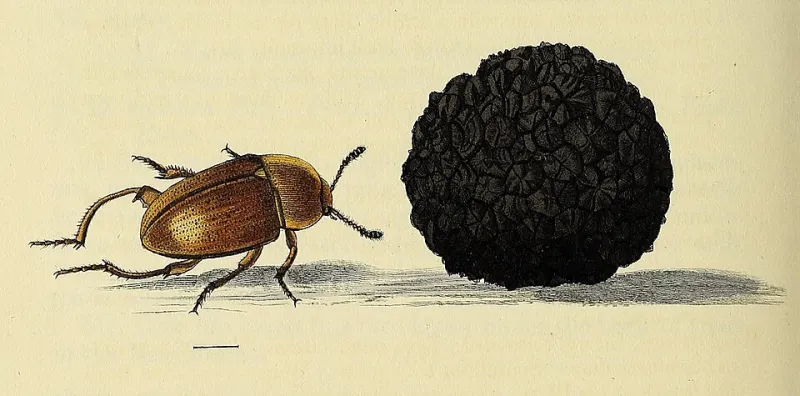
Photo: Curtis, John, 1791-1862, Public domain, via Wikimedia Commons
There is a particular smell to a French truffle market in January: wet earth, diesel from the vans, and something faintly of garlic and hazelnut rising from the baskets. By half past two on a Tuesday afternoon in Lalbenque, the small square behind the church is crowded with growers in fleeces, buyers in city coats, and a scattering of visitors who have come a long way for a kilo of something that looks, frankly, like a muddy stone.
The Périgord black truffle — Tuber melanosporum, the one that matters — is at its best from mid-December to early March. It is also, by a wide margin, the most expensive ingredient most British travellers will ever buy by the gram. A truffle weekend is therefore not a bargain-hunting exercise. It is a slow-living one: cold mornings, woodsmoke, a market that finishes in under an hour, and an afternoon that expands to fill whatever you allow it.
Why midwinter suits the château stay
Anyone who has driven through the Dordogne in August knows the version of the region that appears on postcards: lavender in the verges, swimming pools at capacity, and a certain jostle at the bakery. The truffle season offers the opposite. Châteaux that are fully booked from June to September are quiet in the first week of February, and their rates reflect it. Fires are lit in the salons, the gardens are bare enough to see their bones, and the staff have time to talk.
This matters for British travellers in particular. A Friday-to-Monday break using the tunnel or a morning flight to Bergerac or Toulouse is perfectly feasible, but the region rewards a third night handsomely — a rhythm well established in these pages. Two nights gives you a market and a meal; three gives you a market, a meal, a walk in the woods and a morning doing very little.
The markets worth planning around
Lalbenque, in the Lot, is the serious one. The market runs on Tuesday afternoons from the first week of December until mid-March, and it is short: trading begins at half past two and is frequently over by four. Arrive by two o'clock if you want to watch the pre-market inspection, when truffles are brushed, weighed and graded in the open air. Prices are quoted per kilo and the gap between grades is wide, so ask what you are being shown rather than what it costs.
Sarlat holds its truffle market on Saturday mornings through the winter, under cover and rather more accessible to the casual visitor, with a companion market of producers selling oils, conserves and pommes sarladaises. Martel, Brive and Cahors all run smaller winter markets, and the celebrated market at Richerenches in the Vaucluse — a Sunday morning institution — is worth the detour only if you are already heading east.
A word on etiquette. Do not handle the truffles unless invited, do not wear scent, and carry cash. Growers are pragmatic rather than precious, but they are selling a crop that represents a year's work and they will price accordingly.
Five châteaux that make a sensible base
Château de la Treyne, Lacave (Lot). A fourteenth-century house above a bend in the Dordogne, formal in the best sense, with a Michelin-starred kitchen that treats truffle season as a genuine event. Around forty minutes from Lalbenque; the drive back in the dark is straightforward.
Château de Mercuès, near Cahors (Lot). A Relais & Châteaux property on a vineyard estate, well suited to travellers who want the truffle menu and the Malbec list in one sitting. Its winter packages are among the more transparently priced in the region.
Château les Merles, Mouleydier (Dordogne). Smaller, contemporary in its comforts and convenient for Bergerac airport. Good for a first truffle weekend, and notably relaxed about muddy boots.
Château de la Bourlie, Urval (Dordogne). A family-run house with self-catering options, which allows you to buy at market and cook your own brouillade. The most economical route to a truffle weekend, provided you are happy to make your own breakfast.
Château de Sauveboeuf, Aubas (Dordogne). Close to Sarlat and Montignac, with a calm, unshowy air and a kitchen that understands the difference between a truffle garnish and a truffle dish.
Booking the table without overpaying
Ask two questions before you commit. First, whether the truffle supplement is charged per person or per dish, and second, how many grams are involved. A menu offering 'truffle' for an extra thirty euros is unlikely to involve much of anything; a serious kitchen will tell you the weight without being asked.
Half-board — demi-pension — is usually the better value in January, when châteaux are keen to fill rooms and the restaurant trade is thinner. Book directly with the house rather than through a portal; winter rates are negotiable in a way that summer rates are not, particularly for three nights midweek. And check the minimum-stay conditions, which often rise around Valentine's weekend and the February half-term.
Boots, and the small print
Bring footwear you would take to a point-to-point. Truffle country in February is cold and wet, and the walks that make the weekend — along the marked paths above Lacave, or through the walnut groves near Urval — are not for town shoes. Pack a warm layer for the market, a torch for the drive back, and a small airtight container if you intend to take a truffle home; HM Revenue & Customs treats it as food, but the smell does not respect luggage.
By rail, the useful stations are Souillac and Cahors, both reachable from Paris in a day. By car, the drive from Calais is around eight hours with a stop, which makes an overnight break in the Loire a sensible way to split it.
A shape for three days
Friday: arrive, settle in, eat simply. Saturday: Sarlat market in the morning, lunch of oeufs brouillés and a glass of white, an afternoon walk, dinner in. Sunday: a longer drive to Lalbenque or Martel, depending on the day, and a château table in the evening. Monday: breakfast, a final look at the frost on the parterre, and home.
It is not a cheap weekend. It is, however, one of the few French breaks that genuinely improves with cold weather — and the smell of a market square in January is worth the journey on its own.