Heated, Fenced or Firmly Off-Limits: The Truth About French Château Swimming Pools
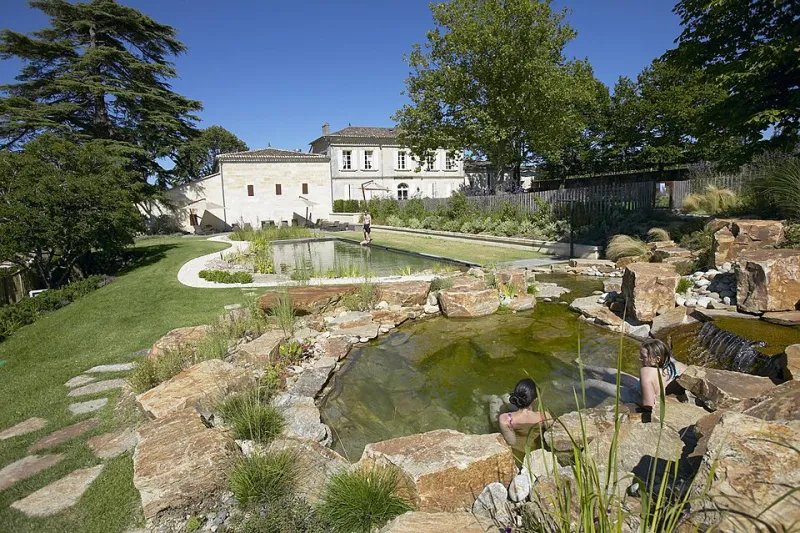
Photo: SunSD, CC BY-SA 3.0, via Wikimedia Commons
Ask a British family to picture a château holiday and a pool will usually appear somewhere in the frame: stonework in the background, a few loungers, water catching the late afternoon light. It is an appealing image, and it is very often the reason a particular property makes the shortlist at all. It is also the single most common source of disappointment in the enquiries we receive. A French château pool can mean almost anything, from a properly heated basin with a pool house and a terrace shaded by lime trees to a small, unheated rectangle that is filled in June and covered again in the first week of September.
The purpose of this guide is not to dampen enthusiasm but to sharpen it. None of the questions below require technical knowledge, and all of them can be settled in a short email before a deposit is paid.
Why the French pool is not the Spanish pool
British travellers arrive with a set of assumptions formed largely by Mediterranean holidays, where a pool is a given, open from April, and warm enough to enter without ceremony. Rural France operates on a different logic. Many château pools are additions to a family house rather than the reason the house exists, and they are run accordingly: opened when the weather justifies it, heated if the owner has chosen to invest in heating, and closed when the season turns. The climate in the Loire, Burgundy or Normandy is generous but not reliably tropical, and a pool that is pleasant in a heatwave can be bracing in a grey July.
Four kinds of château pool
It helps to sort properties into broad types before comparing prices.
The ornamental basin. Historic, often round or rectangular, sometimes fed by a spring, and not intended for swimming. Beautiful to look at, unsuitable for children, and occasionally not even safe to approach. If a listing shows water but says nothing about swimming, assume it is decorative.
The unheated summer pool. The most common category. Typically open from late June to early September, with water that reaches a comfortable temperature only during settled weather. Perfectly good in August, uncertain in May.
The heated family pool. Often the newer installation, sometimes fenced, usually with a heat pump and a cover. This is the type most British families are actually looking for, and it is worth paying a premium for.
The pool-house affair. Heated, terraced, with shade, changing space and a fridge somewhere nearby. Rare, expensive, and genuinely transformative if the pool is central to your plans.
Heating: the question that decides the holiday
When a French listing says a pool is heated, it rarely means heated to a fixed temperature all year. It usually means there is a heating system, deployed during a defined period. Ask three things: what the system is, what temperature the water is held at, and between which dates.
A heat pump maintaining 27°C to 28°C from mid-May to late September is a genuinely different proposition from a solar cover that lifts the water a couple of degrees above ambient in July. Both may be described as 'chauffée'. The distinction matters most for families with young children, who will not tolerate a cold pool, and for anyone travelling outside the school summer holidays.
Fencing, alarms and the safety conversation
French law has required private pools to carry a safety device since 2004 — a barrier, an alarm, a rigid cover or a shelter. A property that is let commercially should comply, but compliance is not the same as being suitable for your family. An alarm that sounds when a child falls in is a legal device, not a substitute for supervision.
Ask which device is fitted, whether the pool is fully fenced, and whether the gate is self-closing. If you have toddlers, a fenced pool with a lockable gate is worth more than a heated one. British parents are also used to lifeguards at public pools and to depth markings; neither should be assumed. Note the depth at both ends, check whether there is a shallow shelf or steps, and ask whether the pool is shared with the owner's family or other guests.
Opening dates and the calendar
This is where the school calendar collides with French practice. A pool that closes in mid-September will be unavailable for October half-term, however warm the autumn turns out to be. A late-May half-term booking is a genuine gamble outside the south. The safest window remains late June to the end of August, with early September often excellent in the south-west and the Midi.
If a pool is the reason for the trip, ask for the opening and closing dates in writing, along with a note of what happens if the heating fails during your stay. A reasonable owner will have an answer.
Pools that earn their place
Among the properties that consistently satisfy British guests, a few patterns recur. The Loire châteaux that have invested in heat pumps tend to open from May and hold their temperature reliably; the Dordogne and Lot properties with pools set above a river valley tend to have the best terraces; and the Languedoc houses, where the season is longest, often combine a heated pool with a shaded outdoor kitchen. Details change with ownership and refurbishment, so treat any recommendation — ours included — as a starting point for your own enquiries rather than a guarantee.
Ten questions to send before you book
- Is the pool heated, and to what temperature?
- What are the exact opening and closing dates this year?
- Which safety device is fitted, and is the pool fully fenced?
- What is the depth at the shallow and deep ends?
- Is the pool shared, and with whom?
- Is there a pool house, shower or changing space?
- How many hours of sun does the pool terrace receive?
- Are pool towels provided, or should we bring our own?
- What is the procedure if the heating or filtration fails?
- Are inflatables and pool toys permitted?
A short packing note
Bring more swimwear than you think necessary, particularly if the pool is unheated and you plan to swim twice a day. British children will want goggles and a rash vest; French pools are relaxed about most things but not about glass near the water. Pool towels are sometimes supplied and sometimes expressly not, so check. And pack a light robe for the walk back across cold flagstones — the one detail almost every guest forgets.
A château pool, properly understood, is one of the great pleasures of a French summer. It simply rewards a little diligence beforehand. Ask the questions, read the answers carefully, and the water will be exactly as you imagined it.